

Why Your Support Payments Matter More Than You Think
Most people think their credit score is tied only to credit cards, loans, or mortgages.
But here’s the reality:
The financial behaviors that matter most in your everyday life—like paying for your child’s expenses, covering family medical bills, or supporting aging parents—are often invisible to your credit score.
Understanding how credit scores actually work is the first step to changing that.
What Is a Credit Score
A credit score is a three-digit number that lenders use to determine how likely you are to repay money you borrow.
It’s calculated using data from your credit report and is designed to measure risk—not effort, responsibility, or real-life financial behavior.
That’s why millions of people who consistently support their families still struggle with low or invisible credit scores.
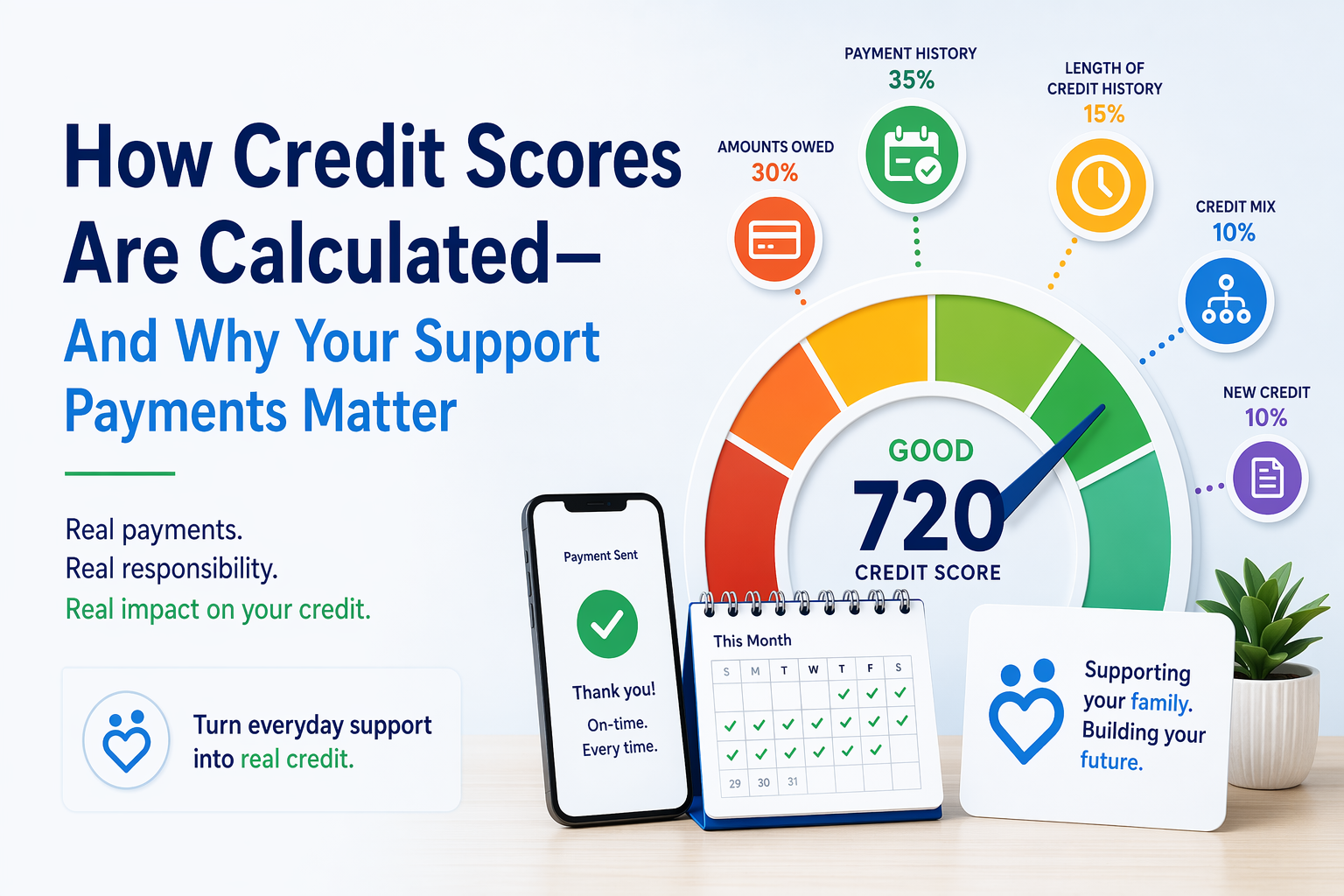
The 5 Factors That Determine Your Credit Score
While different scoring models exist, most—including FICO—evaluate five core factors:
1. Payment History (≈35%)
This is the most important factor.
It answers one simple question:
Do you pay your bills on time?
Late or missed payments can significantly lower your score and stay on your report for years. [myfico.com], [experian.com]
2. Amounts Owed / Credit Utilization (≈30%)
This looks at how much of your available credit you’re using.
- High balances signal financial stress
- Lower usage (generally below 30%) is better for your score [experian.com]
3. Length of Credit History (≈15%)
The longer your credit history, the better.
Lenders want to see a track record—not just recent activity. [myfico.com]
4. Credit Mix (≈10%)
Having a variety of credit types—like credit cards, auto loans, or mortgages—can improve your score. [myfico.com]
5. New Credit / Inquiries (≈10%)
Opening multiple new accounts in a short period can signal risk and temporarily lower your score. [experian.com]
The Hidden Problem: Real-Life Payments Don’t Count
Here’s what most people don’t realize:
Many of the most important payments in your life are not included in your credit score at all.
For example:
- Child support
- Family expense reimbursements
- Caregiving costs
- Informal family loans
- Shared household expenses
Even when these payments are:
- Recurring
- Required
- Paid on time, every month
They typically don’t show up on your credit record.
In fact, traditional systems often only recognize these obligations when something goes wrong.
For example, missed child support payments can be reported and harm your score—but on-time payments usually aren’t reported at all. [legalclarity.org]
Why This Matters
This creates a major gap:
✅ You can be financially responsible
✅ You can consistently support others
✅ You can manage complex, shared financial responsibilities
…yet still not receive any credit for it.
That’s a fundamental flaw in how credit works today.
How Support Payments Directly Impact Credit Factors
When support payments are properly tracked and reported, they can influence the most important parts of your credit score:
Payment History (Biggest Impact)
Consistent, on-time support payments demonstrate reliability—the exact behavior credit scoring models are designed to reward.
Credit History
Regular support payments create a documented financial timeline, helping build a more complete credit profile.
Credit Mix (Indirect Impact)
Adding new types of verified financial activity expands the types of obligations reflected in your credit report.
Financial Stability Signals
Regular, recurring payments show predictability and responsibility—key indicators used in risk assessment.
How SupportPay Closes the Gap
This is exactly what SupportPay was built to solve.
SupportPay transforms everyday support payments into verified, structured financial data that can be used to build credit.
Instead of those payments disappearing, they can:
- Be tracked and documented
- Become certified financial records
- Be reported as positive payment activity (when opted in)
As outlined in SupportPay Credit Boost 20251230, SupportPay reports eligible on-time payments to credit bureaus—helping turn everyday financial responsibility into credit-building activity. [SupportPay…t 20251230 | PDF]
Similarly, monthly payment activity can be reported as a positive credit event, reinforcing on-time behavior in your credit profile. [SupportPay…526_150433 | Word]
Why This Changes Everything
This shift matters because it aligns credit with reality.
Instead of asking: “Do you use credit responsibly?”
It starts recognizing: “Do you manage your real financial responsibilities responsibly?”
That includes:
- Raising children
- Supporting family members
- Managing shared finances across households
The Bottom Line
Your credit score shapes your financial future—but historically, it has ignored one of the most important parts of your life:
how you show up for your family financially.
By understanding how credit scores work—and ensuring your real-world payments are included—you can:
- Build stronger credit
- Improve financial access
- Get recognition for what you’re already doing
Because you shouldn’t have to take on new debt to prove you’re financially responsible.