


Wage garnishment arrives as compliance paperwork, but it signals a much larger workforce financial wellness issue. Learn the real administrative cost, why order volume matters more than employee count, and how employers can turn a payroll burden into a financial recovery benefit.
Garnishment Is Not Just a Payroll Problem
When a wage garnishment order arrives, it usually goes to payroll. Someone opens the envelope or email, reads the order, sets up the withholding, calculates the deduction, remits the funds, and files the paperwork. Compliance is handled. Box checked. Move on.
But for the employee whose paycheck just got smaller, nothing about it is that simple.
Behind every garnishment order is a person dealing with reduced take-home pay, financial stress, limited credit access, and the pressure of trying to keep everything together on less money. That stress does not stay at home. It follows people into the workplace. It shows up as distraction, absenteeism, turnover risk, HR questions, payroll escalations, and reduced productivity.
Most employers already know that financial stress affects workforce stability. Financial wellness programs, earned wage access tools, budgeting apps, and education resources are increasingly common benefits. But there is a gap in most wellness strategies: the employees who are already paying through wage garnishment — employees whose financial responsibility is documented on every pay stub — often receive no recognition, no recovery support, and no path to turn those payments into positive financial progress.
That is the compliance blind spot.
Wage garnishment is treated as a transaction when it could be treated as an opportunity — an opportunity to help employees recover, reduce financial stress, and build credit from payments they are already making. This article explains why employers should think about wage garnishment beyond payroll compliance, what the real administrative and workforce costs look like, and how SupportPay can help turn a compliance burden into a financial wellness benefit.
What Employers Currently Do With Wage Garnishments
Employers and payroll providers are required to process wage garnishment orders. The process typically includes several steps:
- Receive the order. A garnishment notice arrives from a court, agency, creditor, child support office, tax authority, or other issuing entity.
- Review and validate. Payroll confirms the employee, the withholding amount, the applicable limits, and the priority if multiple orders exist.
- Set up the deduction. The garnishment is entered into the payroll system with the correct amount, recipient, and remittance instructions.
- Calculate each pay period. Payroll computes disposable earnings, applies the correct withholding percentage or fixed amount, and ensures compliance with federal and state limits.
- Remit the funds. The withheld amount is sent to the court, agency, creditor, child support disbursement unit, or other designated recipient.
- Manage ongoing changes. Orders may be modified, released, terminated, or replaced. Multiple orders may overlap. Employees may leave, transfer, or change pay schedules.
- Respond to inquiries. Employees may ask payroll about the deduction. Agencies may request confirmation. Legal or HR teams may need records.
This is necessary and important work. Employers must comply. But the process is entirely focused on the transaction. Money in. Money out. Paperwork filed. The employee’s financial outcome is not part of the equation.
The Hidden Administrative Cost of Wage Garnishment
Wage garnishment is not free for employers. Beyond the payroll deduction itself, there are real administrative costs associated with managing garnishment orders.
SupportPay estimates suggest these approximate ranges:
| Cost category | Estimated range | What drives the cost |
|---|---|---|
| Initial setup per garnishment | $150–$500 | Order review, system entry, compliance verification, recipient setup |
| Ongoing monthly management | $75–$200 per active order | Payroll calculations, remittance, record maintenance, employee questions |
| Lifetime cost per garnishment | $500–$1,500+ | Duration of the order, complexity, modifications, multiple orders, turnover |
These costs can vary significantly depending on the employer’s size, payroll system, vendor relationships, legal complexity, number of active orders, order types, and how much manual work is involved. But the key point is that garnishment processing is not a zero-cost activity. It requires time, attention, compliance expertise, and administrative resources.
For organizations with hundreds or thousands of active orders, these costs can add up to a meaningful operational expense — one that is often absorbed without much visibility.
Why Order Volume Matters More Than Employee Count
When employers think about wage garnishment, they often think about how many employees are affected. But the more important number is usually the total number of active garnishment orders.
One employee can have multiple active orders at the same time:
- Child support for one child
- Child support for another child from a different relationship
- A federal tax levy
- A state tax levy
- A student loan garnishment
- A consumer debt judgment
- A medical debt judgment
- A medical support order
Each order may have its own issuing entity, case number, withholding rules, priority, remittance destination, and modification history. Managing five orders for three employees is more work than managing three orders for three employees.
Discovery questions employers should ask
If you are an HR, payroll, benefits, or finance leader, these questions can help you understand the real scope of garnishment in your organization:
- How many active wage garnishment orders is payroll managing today? Not how many employees are affected — how many separate orders are being processed.
- How many new orders arrive each month? This shows whether volume is growing, stable, or seasonal.
- Who owns the process? Is it payroll, HR, legal, finance, a vendor, or shared across teams?
- What part creates the most work? Setup? Ongoing calculations? Modifications? Employee questions? Remittance issues?
- How often do employees contact payroll or HR about garnishments? Employee questions take time and can signal financial stress.
- Do you track the time and cost spent managing garnishments? Many organizations do not, which means the administrative burden may be larger than leadership realizes.
- What happens when an employee with active garnishments leaves? Turnover creates additional paperwork, including notifications to agencies and potential issues with final pay calculations.
These questions help move the conversation from “we process garnishments” to “we understand the real cost and workforce impact of garnishments.”
The Employee Behind the Order
Every garnishment order represents a person. And that person is dealing with more than a payroll deduction.
Employees with active wage garnishments may be experiencing:
- Reduced take-home pay that makes it harder to cover rent, groceries, transportation, utilities, childcare, and medical expenses.
- Financial stress that affects concentration, mood, energy, and decision-making at work.
- Limited credit access because the underlying debt or obligation may have damaged their credit profile, while the ongoing payments may not automatically help rebuild it.
- Higher costs for basic needs because weaker credit can mean higher interest rates on car loans, higher deposits for housing or utilities, and fewer financial options during emergencies.
- Family instability because wage garnishment often involves child support, spousal support, shared expenses, or family-related obligations that create additional emotional complexity.
- Shame and isolation because employees may not want to discuss garnishment with coworkers, managers, or HR.
Financial stress is not just a personal problem. Research consistently shows that financial stress affects workplace outcomes. Employees who are financially stressed may be more distracted, more likely to miss work, more likely to look for another job, and more likely to need additional HR support.
What Traditional Financial Wellness Programs Miss
Many employers have invested in financial wellness programs. These may include budgeting tools, financial education workshops, retirement planning resources, student loan assistance, emergency savings programs, or earned wage access products.
These programs can be valuable. But most of them share a common gap: they do not address employees who are already making significant, recurring, documented payments through wage garnishment.
- Budgeting tools can help employees plan, but they do not change the fact that income is reduced or help garnishment payments build credit.
- Financial education can explain how credit works, but it does not help employees receive credit recognition for payments they are already making.
- Earned wage access can provide liquidity between pay periods, but it does not create a credit-building pathway from existing obligations.
- Retirement planning is valuable long-term, but it does not address the immediate financial stress of reduced take-home pay.
- Student loan assistance helps a specific population, but employees with child support, tax, or judgment garnishments may not benefit.
The missing layer is recovery. Most wellness programs educate or provide access to new tools. Very few help employees turn existing required payments into a potential credit-building signal.
The Missing Recovery Layer
Here is the opportunity most employers are missing:
Payroll providers process garnishments. Financial wellness platforms educate. Earned wage access provides liquidity. But none of these create a recovery layer — a way for employees to receive recognition for the verified payments they are already making.
SupportPay fills that gap.
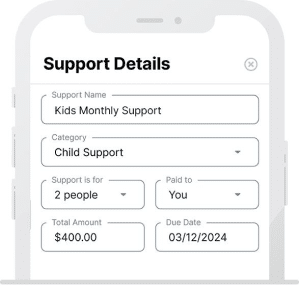
SupportPay helps employees organize family-related financial responsibilities, upload proof such as pay stubs or orders, track payment history, document obligation start dates, and preserve records. For eligible users who opt in, SupportPay Credit Boost can help report qualifying positive payment activity so verified payments may become part of a credit-building record.
The message for employers is straightforward: your payroll team is already processing these payments. Your employees are already making them. SupportPay helps make those payments visible, documented, and potentially credit-building — without encouraging new debt, without requiring a hard inquiry, and without creating additional payroll integration burden.
Why This Matters for Retention and Workforce Stability
The financial stress created by wage garnishment does not just affect the individual employee. It affects the organization.
Consider these workplace impacts:
- Turnover risk. Employees under financial stress may be more likely to leave for a job that pays slightly more, even if the long-term fit is worse. Replacing an employee is expensive.
- Absenteeism. Financial stress can contribute to missed work days — whether due to transportation problems, childcare issues, medical needs, court appearances, or emotional exhaustion.
- Distraction and reduced productivity. An employee worrying about how to cover rent after a garnishment deduction may not be fully engaged at work.
- HR and payroll burden. Employees with garnishments may contact HR or payroll with questions, disputes, or requests for documentation. Each interaction takes time.
- Manager impact. Managers may notice performance changes but not understand the underlying cause, leading to difficult conversations without context.
Helping employees recover financially is not just compassionate — it can be practical. A more financially stable workforce may be a more productive, more reliable, and more engaged workforce.
Employer ROI Framework
Wage garnishment affects a meaningful percentage of the workforce. The exact rate varies by industry, geography, pay level, and employee demographics, but garnishment is not rare.
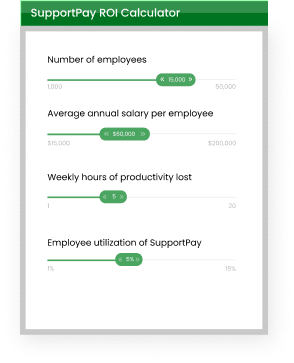
Here is a simplified model showing how supporting employee financial recovery through SupportPay may create value:
| Factor | Example value |
|---|---|
| Total employees | 10,000 |
| Estimated percentage with active garnishments | 8% |
| Employees affected | 800 |
| Estimated annual turnover rate in this population | 40% |
| Employees leaving per year | 320 |
| Average replacement cost per employee | $5,000 |
| Annual replacement cost for this population | $1,600,000 |
If SupportPay helps reduce turnover in the garnishment-affected population by even 10%, that could mean approximately 32 retained employees and an estimated $160,000 in replacement cost savings.
This is a model, not a guarantee. Actual turnover rates, replacement costs, garnishment percentages, and retention impacts vary significantly by organization. The purpose of this framework is to show that even modest improvements in retention among financially stressed employees can create measurable value.
Additional potential benefits that are harder to quantify but still real:
- Reduced absenteeism
- Fewer HR and payroll escalations
- Improved employee engagement
- Stronger employer brand as a company that supports financial recovery
- Differentiation in benefits conversations during recruiting
How SupportPay Works for Employers
SupportPay is designed to be practical for employers and meaningful for employees. Key points for HR and benefits teams:
- No payroll or HRIS integration required for deployment. SupportPay can be offered as a benefit without connecting to payroll systems. This makes launch faster and reduces IT burden.
- Employer does not access private employee financial data. SupportPay messaging states that employers do not see personal family financial records, obligation details, or payment amounts. The benefit is confidential for employees.
- Not a debt product. SupportPay is not a loan, credit card, payday product, or earned wage access tool. It helps employees get recognized for payments they are already making.
- Positioned as easy to launch. SupportPay materials describe deployment as low-lift and achievable in under 30 minutes for many organizations.
- Supports multiple obligation types. Employees can use SupportPay for child support, family support, shared expenses, and other eligible obligations — not just a single garnishment type.
For employers who want to go beyond compliance, SupportPay offers a way to say: “We know wage garnishment is hard. We want to help you make those payments count.”
What This Benefit Communicates to Employees
Benefits are also a communication tool. What an employer offers signals what the employer values. Offering SupportPay as a benefit communicates several things:
- We recognize that financial stress is real. Garnishment is not something to be ashamed of. It is something that can be managed and recovered from.
- We support financial recovery, not just financial education. We are not just telling you to budget better. We are helping your existing responsible payments become visible.
- We do not require you to take on new debt. This benefit is about recognizing what you are already doing right.
- Your payment history has value. Consistent, verified payments may help build credit. We want to help you explore that.
That message can matter to employees who feel invisible in the financial system. It can also matter to prospective employees who are evaluating benefits packages.
Positioning SupportPay in the Benefits Conversation
For HR and benefits leaders who want to position SupportPay alongside existing financial wellness tools, here is a simple comparison:
| Benefit type | What it does | Who it helps most |
|---|---|---|
| Financial education | Teaches budgeting, saving, and credit basics | All employees |
| Earned wage access | Provides early access to earned wages | Employees with cash-flow timing issues |
| Student loan assistance | Helps with student loan repayment | Employees with student loans |
| Emergency savings programs | Encourages short-term savings | Employees without emergency funds |
| Retirement planning | Supports long-term wealth building | All employees |
| SupportPay | Helps employees document payments and explore eligible positive credit reporting | Employees making support, garnishment, or family-related payments |
SupportPay does not replace other financial wellness tools. It fills a gap that other tools do not address: helping employees who are already paying significant recurring obligations receive recognition for those payments.
Messaging for HR Teams
SupportPay does not encourage employees to borrow more money. It helps employees receive recognition for responsible payments they are already making, so they may be better positioned when they need housing, transportation, utilities, insurance, or emergency financial options.
Wage garnishment is already happening in your organization. SupportPay helps turn those compliance transactions into a financial recovery benefit for the employees behind them.
The Compliance-to-Wellness Shift
Every payroll team already processes garnishments. The orders arrive. The deductions happen. The money is remitted. That is compliance.
But compliance alone does not reduce financial stress, improve credit access, lower turnover, decrease absenteeism, or help employees recover. It does not make the payments count for anything beyond the obligation itself.
The shift from compliance to wellness happens when employers look at garnishment not just as a transaction to process but as a signal that employees may need support — and when employers offer practical tools that can help.
SupportPay is designed to be that practical tool. It helps employees organize records, track payments, document obligation start dates, upload proof, and explore whether eligible verified payments can support positive credit reporting through Credit Boost. It does not require payroll integration, does not expose private employee data, and does not encourage new debt.
If your organization already processes wage garnishments, SupportPay can help turn that compliance burden into a recovery benefit for the employees who need it most.
Start Now
If your payroll team already processes wage garnishments, SupportPay can help turn that compliance activity into a financial recovery benefit for employees. Learn how SupportPay helps employees document payments, organize records, and explore whether eligible verified payments can support positive credit reporting — without payroll integration and without encouraging new debt.
FAQ: Wage Garnishment and Employer Compliance
How much does it cost employers to process wage garnishments?
Costs vary, but estimates suggest $150–$500 to set up a typical garnishment, $75–$200 per month to manage an active order, and $500–$1,500+ over the life of a single garnishment depending on complexity, duration, and order volume.
Does SupportPay require payroll integration?
No. SupportPay materials position launch as low-lift and not requiring payroll or HRIS integration for deployment.
Does the employer see private employee financial data?
No. SupportPay messaging states employers do not access personal family financial records, obligation details, or payment amounts. The benefit is confidential for employees.
Is SupportPay encouraging employees to take on debt?
No. SupportPay is not a loan, credit card, or debt product. It helps employees get recognized for payments they are already making through wage garnishment, child support, family support, or shared expenses.
How does this benefit differ from earned wage access?
Earned wage access provides early access to earned wages. SupportPay focuses on documenting and reporting eligible positive payment behavior tied to real obligations. They solve different problems and can complement each other.
How does this differ from financial education?
Financial education teaches concepts. SupportPay helps employees take action on existing payments by organizing records and exploring eligible positive credit reporting. Education explains what to do. SupportPay helps make existing responsible payments visible.
Can this help with employee retention?
Financial stress contributes to turnover, absenteeism, and reduced productivity. Helping employees recover financially may support retention, but results vary by organization and are not guaranteed.
What types of payments can employees track with SupportPay?
Employees can use SupportPay for child support, family support, shared expenses, and other eligible obligations. The platform is designed for family-related financial responsibilities.